
Skiing in Abruzzo – snow report
The most popular ski resorts, the updated snow report and useful information on how to find lifts or book accommodation for your winter holiday


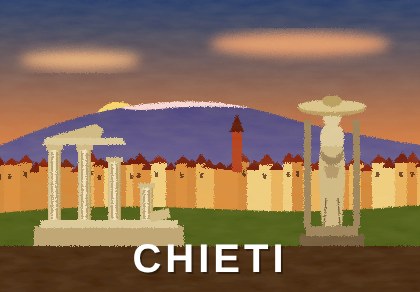
Chieti is one of the oldest cities in Italy: its old town, Chieti Alta, sits on a hill at about 330 metres, looking towards the Majella on one side and the sea on the other; the modern district, Chieti Scalo, lies in the valley below. This guide covers monuments, museums, itineraries, typical dishes, events and practical information for visiting the city and its surroundings.
The most popular ski resorts, the updated snow report and useful information on how to find lifts or book accommodation for your winter holiday

View the webcams in Abruzzo and check real‑time weather conditions. Some webcams belong to www.abruzzoparchi.it, others are located throughout the region

Weather forecasts for the coming days in Abruzzo. Live weather via our webcams and temperatures recorded in several mountain areas

Maps for trekking, mountain biking, ski touring, running and horse riding. You can also download the GPX track of each route

Abruzzo’s villages are famous for their fortresses, mountains and the traditional trabocchi along the southern coast

One of Italy’s most famous and oldest national parks


Located in the heart of the Apennines, home to the beautiful villages of the Rocche Plateau

One of the snowiest places in Italy, a unique mountain massif rising close to the sea

Choose between sea or mountains, summer or winter, a sporty holiday or a relaxing one — Abruzzo has it all

Abruzzo is famous for its cuisine, both mountain and coastal, with traditions that vary from area to area
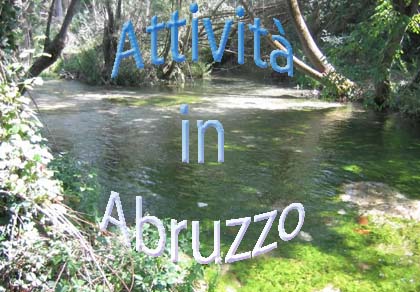
Walks, diving, climbing, mountain biking, horse riding — all outdoor activities available in Abruzzo
Rocca di Mezzo, Rocca di Cambio, Rovere, Terranera, Ovindoli

The Medieval Villages of the Gran Sasso, with their castles, towers, and ancient settlements that once dominated Abruzzo

The village of Cappadocia, in the western part of the Aquilan Abruzzo

The village of Casamaina, a favourite among skiers heading to Campo Felice or Ovindoli

The village of Castel del Monte, the highest settlement in the Gran Sasso area

The village of Civitella Alfedena, in the Abruzzo, Lazio and Molise National Park

Mountaineering on the Gran Sasso, the ideal place for freeride lovers seeking demanding routes

The city of L'Aquila, with its restored Renaissance palaces, a place rich in culture

The 2012 snowfall in L'Aquila brought over one metre of snow in 24 hours — unbelievable images

The village of Pescasseroli, heart of the Abruzzo, Lazio and Molise National Park

The village of Pietracamela, on the north-eastern side of the Gran Sasso, at the foot of Corno Piccolo — a magical and unexpected place

Prati di Tivo, a winter ski resort offering breathtaking views to all who visit

San Domenico and the Serpari ritual, held every first Thursday of May

The 2012 snowfall in Scoppito reached nearly two metres in height

The village of Opi, a splendid settlement in the Abruzzo, Lazio and Molise National Park
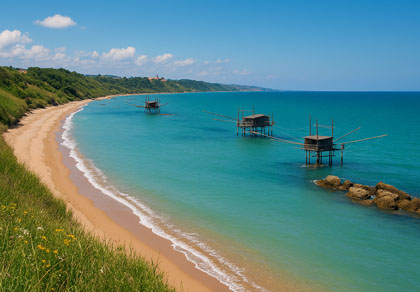

Punta Aderci, with the Abruzzese trabocchi stretching from Vasto through Fossacesia to San Vito Chietino

Lake Campotosto, nestled between the Gran Sasso and Monti della Laga ranges, within the national park of the same name

The Capodacqua reservoir, with submerged mills and crystal-clear waters, a paradise for divers

The swimming lake of Scanno, named after the village overlooking it — a place worth visiting

Lake Sinizzo, just a few kilometres from San Demetrio, is the ideal place for nature lovers seeking fresh, clear waters

Lake San Domenico, named after the nearby hermitage; its crystal-clear waters make it unique. Swimming not allowed

The Fountain of the 99 Spouts, a symbol of the city of L'Aquila

The Basilica of Santa Maria di Collemaggio, resting place of Pope Celestine V, the only pope buried outside Rome’s walls

The Sanctuary of Madonna d'Appari, set among the rocks along the road between Paganica and Assergi

The Church of San Panfilo, in the municipality of Tornimparte, with its frescoes — a place worth visiting

The Stiffe Caves, inside the Velino-Sirente Regional Park — a magical place to explore
A hilltop city between the Majella and the Adriatic. Roman temples in the heart of town, the Warrior of Capestrano in the Villa Frigerj museum and one of the oldest Good Friday processions in Italy.
Roman temples, a thousand-year-old cathedral and two major archaeological museums.
The cathedral, dedicated to the patron saint, was rebuilt under the Normans and consecrated in 1069. Bartolomeo di Giacomo began the bell tower in 1335 and Antonio da Lodi completed it in 1498; the Gothic crypt holds the relics of San Giustino and 14th–15th-century frescoes.
In the heart of town, near Corso Marrucino, the remains of a group of Roman temples brought to light in 1935. The two twin temples were commissioned in the 1st century AD by Marcus Vettius Marcellus and Helvidia Priscilla.
Built between 1813 and 1817 as the Royal Theatre of San Ferdinando and opened in 1818 with Rossini’s La Cenerentola, it took its present name after Italian unification. It stands a few steps from the cathedral.
In the neoclassical villa inside the public gardens you can see the Warrior of Capestrano, a 6th-century BC statue, in a room designed by Mimmo Paladino. Open Tuesday to Sunday.
On the acropolis of ancient Teate, the museum tells the story of the city from its origins to Roman times and of the Marrucini territory. Next to it are the remains of the 1st-century AD amphitheatre, and the terrace looks out over the Majella.
The remains of the baths connected to a large underground cistern, part of the city’s ancient water system.
Probably founded in 1239, it faces Corso Marrucino.
The city’s large park, opened to the public in 1868 by joining the gardens of the Frigerj and Nolli villas. It contains Pietro Canonica’s war memorial, unveiled in 1924.
The main street of Chieti Alta, with arcades, shops, cafés and historic palaces, linking the cathedral area with the public gardens.
The religious and civic heart of the city, with the cathedral and Teatro Marrucino.
The old town on the hill and the modern city in the valley, with the station, the university campus and shopping areas.
The acropolis of the ancient city, with the museum, the amphitheatre and one of the finest views of the Majella.
In less than an hour you go from the Majella woods to the Adriatic beaches.
Chieti lies between the Majella and the coast, so it is easy to combine a day in the mountains with a day at the sea.
About 35 km away: ski slopes in winter and trails in summer, with the park hiking guide.
About 28 km away, the “city of stone” at the foot of the Majella, famous for its crafts. See Guardiagrele.
Francavilla al Mare, Ortona and the Trabocchi Coast with its cycle path: see the Abruzzo coast.
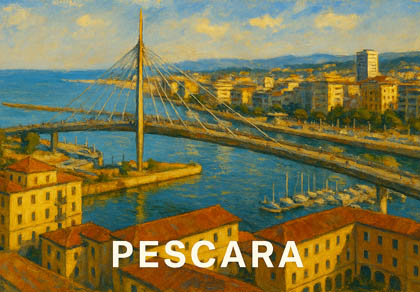
About 15 km away, with the airport, seafront and museums. See Pescara.
From short walks to a full day.
A university city, lively during the academic year.
The “G. d’Annunzio” University, with its main campus in Chieti Scalo, brings thousands of students to the city.
Religious rites, music and street performances.
One of the oldest in Italy, led by the Confraternity of the Sacro Monte dei Morti. It is accompanied by the 18th-century Miserere by Saverio Selecchy, performed by about 150 musicians and 160 singers.
The patron saint festivities take place in May: San Giustino is celebrated on 11 May.
Street-artist festival in the old town in mid-August.
A week of concerts and shows in July.
Chieti cooking brings together mountain, hill and seaside dishes.
The old town is on the hill and best explored on foot; buses and trolleybuses climb up from Chieti Scalo.
From the Marrucini to a university city.
Chieti was the main town of the Marrucini, an Italic people; the Romans called it Teate Marrucinorum. Legend says it was founded by Achilles and that the name Teate comes from his mother, the nymph Thetis: that is why the city’s coat of arms shows the hero armed with spear and shield.
After the Social War (91–88 BC) the Marrucini obtained Roman citizenship. The temples, baths and amphitheatre date from the imperial age.
Destroyed in 801 by Pepin, son of Charlemagne, the city recovered under the Normans: the new cathedral was consecrated in 1069. At the end of the 13th century Charles I of Anjou made it the capital of Abruzzo Citra.
In the Second World War Chieti was declared an open city and was liberated on 9 June 1944. Today it is home, together with Pescara, to the “G. d’Annunzio” University.
The most popular ski resorts, the updated snow report and useful information on how to find lifts or book accommodation for your winter holiday
Vai
View the webcams in Abruzzo and check real‑time weather conditions. Some webcams belong to www.abruzzoparchi.it, others are located throughout the region
Vai
Weather forecasts for the coming days in Abruzzo. Live weather via our webcams and temperatures recorded in several mountain areas
Vai
Maps for trekking, mountain biking, ski touring, running and horse riding. You can also download the GPX track of each route
Vai
Walks, diving, climbing, mountain biking, horse riding — all outdoor activities available in Abruzzo
Vai
Choose between sea or mountains, summer or winter, a sporty holiday or a relaxing one — Abruzzo has it all
Vai
Abruzzo is famous for its cuisine, both mountain and coastal, with traditions that vary from area to area
Vai
Abruzzo’s villages are famous for their fortresses, mountains and the traditional trabocchi along the southern coast
Vai
One of Italy’s most famous and oldest national parks
Vai
One of Italy’s wildest parks, with typical Apennine landscapes and Dolomite‑like peaks
Vai
Located in the heart of the Apennines, home to the beautiful villages of the Rocche Plateau
Vai
One of the snowiest places in Italy, a unique mountain massif rising close to the sea
Vai